Tuesday, 25 March 2014

4. New Theories on Tut: Analyzing Salima Ikram’s Article

In Salima Ikram’s article, Some Thoughts on the Mummification of King Tutankhmun, she looks at the ways in which King Tut’s burial and mummification process differed from other kings, and what this might mean.  Anomolies in King Tut’s tomb include, the excessive amounts of resin placed on the body, the abnormal placement of the hands, missing ribs (possibly taken by Carter), and his mummified erect penis ( Ikram, 293-95). Additionally, scans of Tutankhmun’s body has revealed that his heart was removed, while his diaphragm is intact (typically it is cut through to reach the lung, (Ikram, 296). These findings are interesting as the lacerations on the body are consistent with an embalming process, but the chest was apparently wide open, leading Ikram to ask, “why bother?” (Ikram 296).

            Ikram notes that the removal of the heart is strange, as it is a key part of the resurrection process (296).  Often a scarab would be placed beside the body as well as a way of providing safe passage to the afterlife; however, this grave good is absent as well.

The main discussion in Ikram’s article surrounding these anomalies suggests that, rather than a series of unfortunate mishaps, the strange way in which tut was buried and mummified, was part of a theological process (298). The central theory in the article is that the mummification process was to personify him as Osiris.  Egyptologists believe that for most kings, the living king was Horus and the dead, Osiris, this is seen in many tombs as a king being offered up to Osiris (Ikram, 298). 
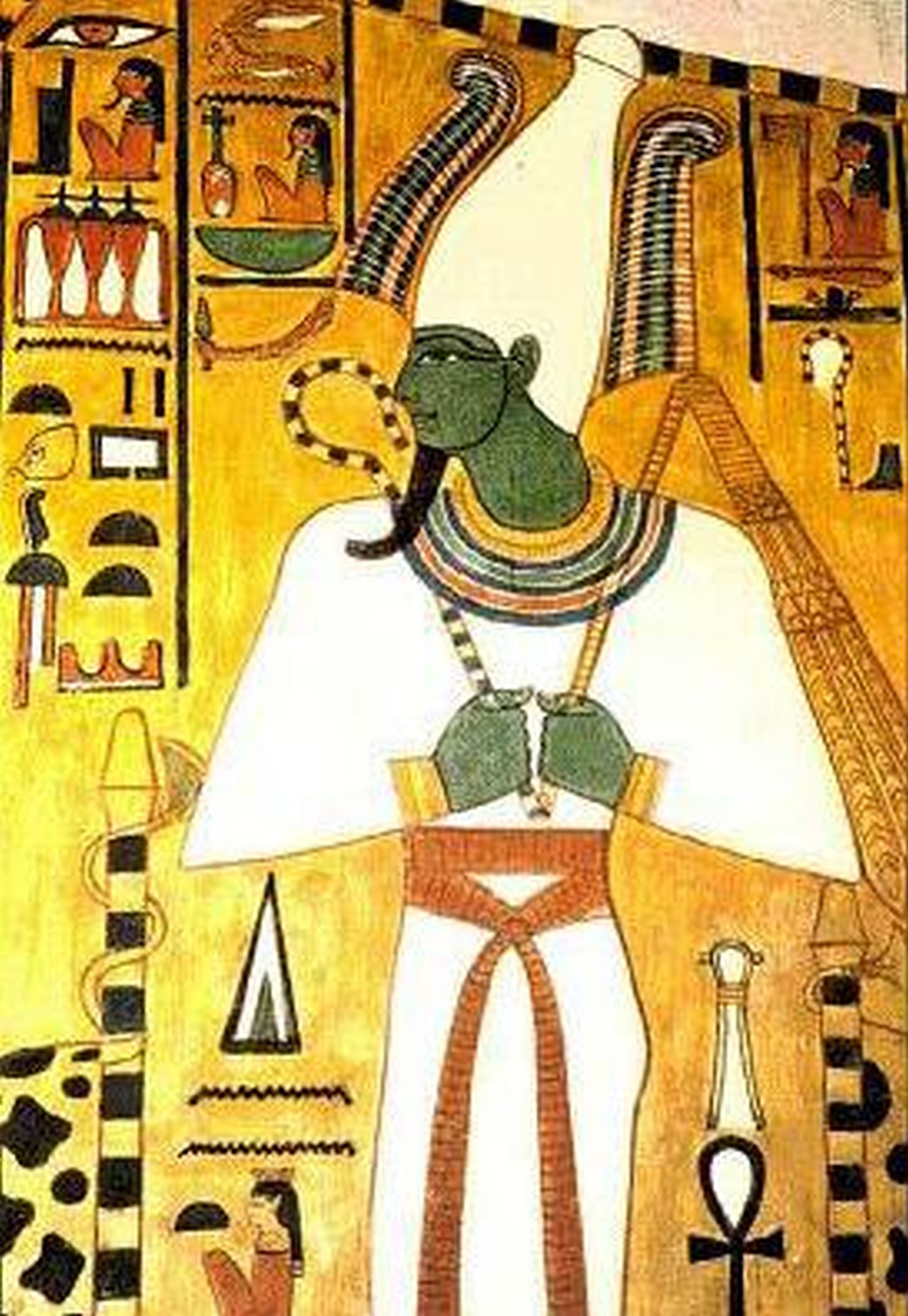
Osiris 

However this seems to be emphasized more in Tut’s tomb, and tut is portrayed as the embodiment of him (Ikram 298). Ikram attempts to explain the abnormalities in Tut’s grave as signals to this. For example, the excessive resin (which is black in colour) could be homage to Osiris as the lord of the Egyptian land, “dark with the rich soil of the inundation, and the source of fertility and regeneration” (Ikram, 299). Essentially, the purposeful mummification differences Tut experienced are possibly part of his deification to Osiris.


            Ikram’s article raises many questions about a subject that is difficult to track. Ikram makes a point to consistently label the evidence as theory and not fact. With that said Ikram seems to dismiss many claims that Carter’s original research may have had flaws. Nevertheless, that we are still able to pose new ideas about a discovery made 92 years ago speaks to the complexity of the tomb.


Sources:

 Ikram, S. 2013. Some Thoughts on the Mummification of King Tutankhamun. Etudes et Travaux. 26(1): 292-301.
N.d. File:Osiris-tomb-of-Nefertari. Web. 28 Mar. 2014. <http://commons.wikimedia.org/wiki/File:Osiris-tomb-of-Nefertari.jpg>.

Monday, 24 March 2014

5.Tutankhamun is Osiris


In order to try to answer the questions posed in our first blog post:
What was the purpose of these anomalies in the mummification of King Tutankhamun?
Why was Tutankhamun mummified in a way different from most other mummies of the time?
Was Tutankhamun already considered a deity during his mummification?
We must look into the god Osiris, who Salima Ikram believes Tutankhamun was mummified as, so as to discover any similarities that would have allowed for Tut’s mummification as a god.

The tale of Osiris

Courtesy of Geoffrey L. https://www.youtube.com/watch?v=NBGVcnFAmrg


Osiris became Egypt’s king in a time of turmoil. It is Osiris that is credited with taking the people of Egypt from their barbarous ways, and teaching them about sowing and reaping, earning himself the title of Grain God, associated with agriculture, growing crops and changing seasons. But most importantly, Osiris taught the Egyptians about the gods and worshipping the gods (Budge 1961). 


Perhaps this is why Tutankhamun was mummified as Osiris, for it was Tutankhamun that restored the god’s following his father’s reign. This action of restoring the gods to their rightful places of worship likely created an affinity between Tutankhamun and Osiris. Granting him the right, as decided by those conducting the mummification and his successor Ay who played an integral part in Tutankhamun’s mummification, to be deified as Osiris. This was a rarity in Egypt, as it is believed that no king could assume the position or shape of any existing god to prove divinity, as no mortal could occupy the position of an Egyptian god. (Wildung 1977)

  The evidence for this deification can be seen in the abnormalities observed in Howard Carter and Douglas Derry’s examination of Tutankhamun. Beginning first with the overabundance of libations, which were intended to give new vitality, and as Ikram believes, allude to the black colour associated with Osiris, the source of regeneration and fertility. Ikram also believes that their place of import from Lebanon/Syria might evoke the time Osiris spent in a pillar in Levant (2013). Secondly, also connected with the idea of Osiris being the god of fertility, is the purposeful mummification of Tutankhamun’s penis in an erect position. This likely refers to the legend of Osiris impregnating Isis after his death, and is symbolized with Tutankhamun’s penis being mummified in an erect position. (Budge 1961)


(Leek 1972, Plate XIV)

   Tutankhamun’s abnormal arm position could also be indicative of his representation as Osiris through trying to make Tut’s elbows appear more pronounced, as was seen in images of Osiris (Ikram 2013). This desire to make Tut appear more like Osiris could also be the explanation for the overabundance of linen wrappings around Tutankhamun’s head. Described by Carter as “of conical form and its shape suggestive of a crown”, they are believed to resemble the headdress of Osiris and have not been found on any other mummy to date (Leek 1972). Also believed to add to Tutankhamun’s appearance of a deity is the placement of a two plain straps of golden leaves placed on the breast of the body and decorated with a knot. This corselet with a single strap can be seen on statues and base-reliefs of Egyptian kings, a double strap, as was seen on Tutankhamun, was reserved for gods, therefore adding to the belief that Tutankhamun was already considered a god when he entered into the embalming workshop (Desroches-Noblecourt 1989).
(Leek 1972, Plate X)

  The final anomaly, although not mentioned by Derry or Carter due to an inability to examine the chest cavity which was packed with linen and resin, is the absence of a heart (Leek 1972). This absence is purposely done, as the heart remained in the body in most mummifications, and likely alludes to Osiris being split into pieces by his brother Seth, and his heart being taken (Budge 1961).

  Although there is considerable evidence that points to Ikram’s theory that Tutankhamun was mummified as Osiris, therefore a deity once he entered the embalmer’s workshop, it is best to keep in mind that this is complete speculation. Although we can make comparisons between anomalies in Tutankhamun’s mummification and the stories of Osiris, without any records pertaining to Tutankhamun’s death or mummification we cannot say indefinitely that Tutankhamun was mummified as Osiris.

Works Referenced
Budge, W. (1961) The Egyptian Religion of Resurrection: Osiris. New York: University Books.

Ikram, S. (2013) Some Thoughts on the Mummification of King Tutankhamun. Etudes et Travaux. 26(1): 292-301.

Leek, F. (1972) The human remains from the tomb of Tut’ankhamun. Oxford: University Press.

Wildung, D. (1977) Egyptian Saints: Deification in Pharaonic Egypt. New York: New York University Press.